How Should Schools Promote Device Insurance to Parents During Open Enrollment?
 05.14.2026
 Matt Morelli
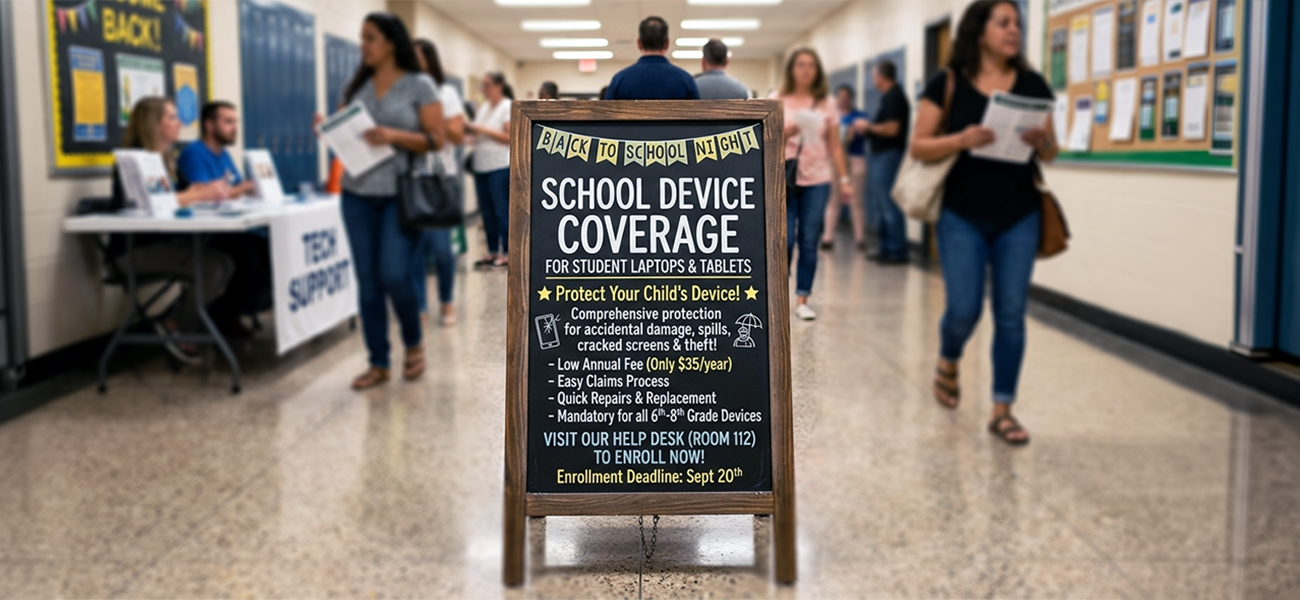
When a school or district offers a student device insurance program, parents usually learn about it through more than one communication channel. For School Device Coverage during the 2025/2026 school year, the most common ways parents heard about the program were flyers, back-to-school night, email, and signs at school. The takeaway for districts is clear: one announcement is not enough. Parents are busy, back-to-school season is crowded, and device protection messages need to appear repeatedly across every available channel during open enrollment.
School Device Coverage insures school-issued laptops, iPads, Chromebooks, and other electronics used in school or district 1:1 programs. The program is designed to help protect families and districts from the cost of accidental damage, loss, theft, cracked screens, water damage, electrical failure, vandalism, and other covered incidents.
How Parents Heard About School Device Coverage in 2025/2026
Each year, School Device Coverage interviews parents to better understand how they first heard about the insurance program offered through their school or district.
For the 2025/2026 school year, parents reported the following sources:
| How Parents Heard About SDC | Count | Percent of Total |
|---|---|---|
| Flyer | 2,823 | 31% |
| Back to School Night | 1,728 | 19% |
| 1,721 | 19% | |
| Signs at School | 1,310 | 14% |
| Other | 1,167 | 13% |
| Word of Mouth | 338 | 4% |
| Facebook/Social Media | 95 | 1% |
| Total | 9,182 | 100% |
The strongest result was not a single digital channel. It was the combination of physical, in-person, and digital communication.
Flyers accounted for 31% of parent awareness, making them the top reported source. Back-to-school night and email each accounted for 19%, showing that both in-person events and direct digital reminders play a major role. Signs at school contributed another 14%, proving that simple on-campus visibility still matters.
The best parent communication strategy is not digital-only, print-only, or event-only. It is all of the above, repeated often.
Why One Announcement Is Not Enough
Districts often do promote student device insurance. The challenge is that many promote it only once, or only through one or two channels.
That creates a visibility problem.
Parents are receiving information about schedules, transportation, meals, forms, classroom assignments, sports, fees, supplies, and technology expectations all at the same time. Even an important message can be missed if it appears only once.
A parent may overlook the first email. Another may miss back-to-school night. Another may see a flyer but forget to enroll. Another may not realize the district-issued Chromebook, iPad, laptop, or tablet could result in repair or replacement costs if it is lost, stolen, or damaged.
That is why districts should treat device insurance communication as an open enrollment campaign, not a one-time notice.
What the 2025/2026 Parent Data Shows
The parent response data points to three important lessons for schools and districts.
1. Flyers Still Work
Flyers were the leading source of parent awareness, representing 31% of responses.
This matters because many districts have shifted heavily toward digital communication. Email, portals, apps, and websites are useful, but printed material still reaches families in a direct and familiar way.
A flyer can go home with a student. It can be included in a registration packet. It can be handed out during device pickup. It can be posted near the technology desk or front office.
For school device insurance, flyers are especially useful because the decision is practical and time-sensitive. Parents need to understand what the program covers, when enrollment closes, and how to sign up.
2. Back-to-School Night Is a High-Value Communication Moment
Back-to-school night accounted for 19% of parent awareness.
That is a strong signal. When parents are on campus, already thinking about the school year, and already hearing from teachers and administrators, they are more likely to pay attention to device protection.
Districts should make School Device Coverage part of the back-to-school conversation. This can include a short announcement, a table near device pickup, QR codes on handouts, posters in hallways, and reminders from school staff.
The goal is not to overwhelm parents. The goal is to make sure they know the option exists before a cracked screen, water spill, loss, or theft creates a costly surprise.
3. Email Matters, But It Should Not Carry the Whole Campaign
Email also accounted for 19% of parent awareness.
Email is essential because it gives districts a fast, low-cost way to reach families during open enrollment. It also allows schools to include direct links, deadlines, coverage details, and reminders.
But email should not be the only communication method.
Families may miss messages because of crowded inboxes, outdated contact information, language preferences, spam filters, or simple timing. A single email is easy to ignore. A coordinated sequence of emails, paired with flyers, signage, event reminders, and website placement, is much harder to miss.
The Best Communication Plan Uses Every Available Channel
The most effective districts do not rely on one message in one place. They build a communication rhythm across the full enrollment window.
A strong school device insurance communication plan should include:
- Flyers sent home with students
- Emails to parents and guardians
- Back-to-school night announcements
- Signs near school entrances, offices, and technology pickup areas
- Website and parent portal placement
- Text or app reminders, when available
- Social media posts
- Device distribution packet inserts
- Mentions in principal newsletters
- Reminder messages before enrollment closes
The most important part is repetition. A district may need to share the same core message several times before a parent sees it, understands it, and takes action.
What Districts Should Say to Parents
The message should be simple, practical, and repeated consistently.
Parents need to know:
- Their student is receiving or using a school-issued device.
- The device may be expensive to repair or replace.
- The district is offering an insurance option through School Device Coverage.
- The program can cover common incidents such as accidental damage, loss, theft, cracked screens, water damage, electrical failure, and vandalism, depending on the policy terms.
- Enrollment is available for a limited time.
- Signing up now can help avoid larger out-of-pocket costs later.
The best version of the message is direct:
Protect your student's school-issued device before accidents happen. School Device Coverage gives families an affordable way to insure eligible laptops, Chromebooks, iPads, and tablets during the school year.
A Sample Open Enrollment Communication Schedule
Districts should communicate before, during, and near the end of the enrollment period.
Before School Starts
Announce that device insurance will be available. Include the information in registration materials, device pickup instructions, parent portals, and back-to-school emails.
First Week of School
Send a dedicated email and distribute flyers. Post signs in school offices, libraries, technology areas, and device distribution locations.
Back-to-School Night
Mention School Device Coverage during general announcements. Provide QR codes, flyers, and staff reminders at check-in or technology tables.
Mid-Enrollment Period
Send a reminder email. Add a short note to the principal newsletter. Post again on school communication platforms.
Final Week of Enrollment
Send deadline-focused reminders. Use clear language such as “Enrollment closes soon” or “Last chance to protect your student's school-issued device.”
Why This Matters for Districts
A school device insurance program can only help families who know it exists.
School Device Coverage offers parent buy, district buy, and hybrid program options, allowing districts to choose an approach that fits their needs and budget. For parent buy programs especially, communication has a direct impact on participation.
When more parents understand the program, more families have the opportunity to protect school-issued devices before damage, loss, or theft occurs.
That can help reduce confusion, improve preparedness, and make device management easier for schools, technology teams, and families.
The Bottom Line for Schools and Districts
Parents do not hear about school device insurance the same way.
In the 2025/2026 school year, School Device Coverage parent interviews showed that families learned about the program through flyers, back-to-school night, email, signs at school, word of mouth, social media, and other channels.
That is why districts should not depend on one announcement.
The strongest enrollment results come from repeated communication across every channel parents already use.
Flyers matter. Email matters. Back-to-school night matters. Signs matter. Parent portals, newsletters, and reminders matter.
The more consistently a district communicates, the more likely parents are to understand their options before something happens to their student's school-issued laptop, Chromebook, iPad, or tablet.